
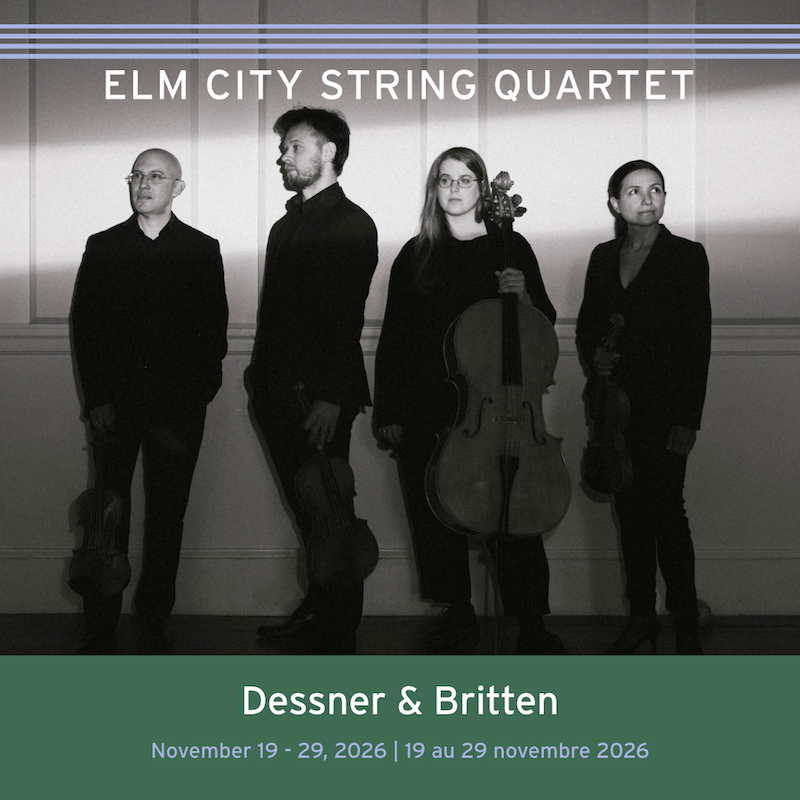
It’s concert week! Our second tour of the year begins this Thursday in Saint John. This show features Emily’s favourites — Bryce Dessner’s “Impermanence” and Benjamin Britten’s Quartet No. 2. We’ve been hard at work getting this show ready; it’s demanding repertoire, both mentally and physically - which is why this program features only the two pieces. Emily happily takes ownership over these demands: it’s such excellent music that the finger calluses have been worth it!
The ECSQ Plays Dessner & Britten
Saint John - November 19th, 7:30PM:
Saint John Arts Centre
Fredericton - November 20th, 7:30PM:
Wilmot United Church
St. Andrews - November 22nd, 3:00PM:
Wesley United Church [PLEASE NOTE NEW DATE]
Moncton - November 25th, 7:30PM:
Centre culturel Aberdeen
Bathurst - November 29th, 3:00PM:
First United Church

Bryce Dessner - Impermanence
Bryce Dessner is a vital and rare force in new music. He has won Grammy Awards as a classical composer and with the band The National, of which he is founding member, guitarist, arranger, and co-principal songwriter. He is regularly commissioned to write for the world’s leading ensembles, from Orchestre de Paris to the Los Angeles Philharmonic, and is a high-profile presence in film score composition, with credits including The Revenant, for which he was Grammy and Golden Globe nominated; Fernando Mereilles’s The Two Popes; Mike Mills’ C’mon C’mon; Bardo, by Alejandro González Iñárritu; and Rebecca Miller’s She Came to Me. Dessner collaborates with some of today’s most creative and respected artists, including Philip Glass, Sufjan Stevens, Thom Yorke, Nico Muhly, and Steve Reich. His orchestrations can be heard on the latest albums of Paul Simon, Bon Iver, and Taylor Swift.
Impermanence reflects on the ephemeral nature of life, the perfect subject matter for a live performance; fleeting and vulnerable. The project was inspired by fire; Notre Dame had just burnt down, and the Australian bush forests were burning at catastrophic magnitude. Bryce Dessner and Sydney Dance Company choreographer Rafael Bonachela wanted to create a work that represented the fragility of seemingly eternal things, and the juxtaposition of beauty and destruction. The result was a full ballet that finally premiered in 2021 after delays due to COVID-19. We were thrilled to be the first in Canada to present the piece when the sheet music became available for public performance during our 202425 season, we are thrilled to once again be sharing selections from this incredible piece. While we (still) aren’t including any dance choreography, the music stands alone as a moving and evocative reflection on life, change, death, and continuation.
The Australian String Quartet recorded excerpts from the ballet, which was released back in 2021. You can hear the recording on Bandcamp here:
If you’re a fan of Philip Glass or Caroline Shaw, we think you’ll love the Dessner. Here’s a clip from the ballet’s choreographer explaining the inspiration behind the piece.
Benjamin Britten - Quartet No. 2
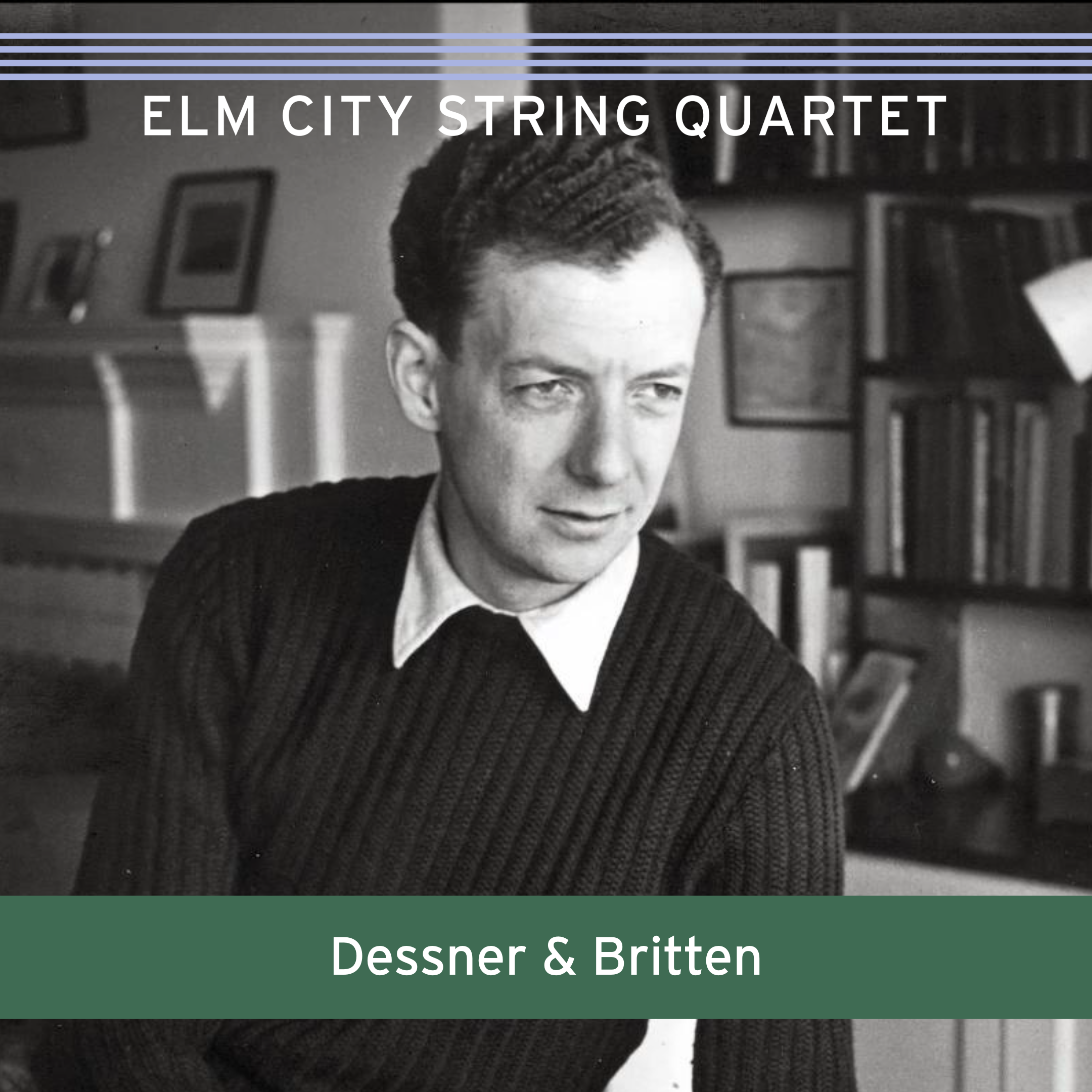
Benjamin Britten was an English composer born on November 22nd, 1913: the feast day of St. Cecelia, Patron Saint of Music. His birth date pleased his mother, who was determined that he should be a great musician, and would often talk about the three B’s – Bach, Beethoven, and Brahms – and that the fourth “B” was to be him. He lived up to his mother’s dreams: during his lifetime, he was regarded as one of the truly great creative giants of the 20th century. His achievements were officially recognized in 1976, when he became the first composer to be made a Lord, an honour bestowed by Queen Elizabeth II.
While Britten was often regarded as one of the premiere composers to have emerged from England, his music is uniquely separate from the pastoral “English” sound often associated with composers like Vaughan Williams. Instead, he was heavily inspired by Elizabethan-Era composer Henry Purcell, and strove for qualities of “clarity, brilliance, tenderness and strangeness” in his work. His String Quartet No. 2 is in fact a dedication to Henry Purcell, and was composed and premiered in 1945 for a commemorative concert on the 250th anniversary of his death (coincidentally November 21st, one day before Britten’s own birthday).
His String Quartet No. 2 doesn’t directly quote Purcell, but the last movement (which is longer than both the first and second movement combined) is titled Chacony – a composition technique made up of a set of variations based on a short, recurring harmonic progression that Britten associated with Purcell. The last movement has 21 variations (perhaps an ode to Purcell’s anniversary date) organized into four sets separated by solo cadenzas from the cello, viola and first violin, making the movement almost like its own 4-movement inner quartet. For an equally epic conclusion, the last variation features 21 C Major chords.
The quartet was one of the first works he composed after returning from a recital tour of the recently liberated German concentration camps with violinist Yehudi Menuhin. Quartet No. 2 is notably darker than his previous works, and his partner Peter Pears noted that what he witnessed on the tour shocked him so much that he couldn’t speak of it until the end of his life, and that the experience coloured everything he had composed since. All the proceeds from the quartet’s premiere were donated to a fund for survivors of the 1943 Bengal famine, a man-made food crisis in the Bengal province of British India caused by harmful British colonial policies during WWII.
With the power of Youtube, we are now lucky to be able to hear the very first recording of the quartet — Britten even made a guest appearance on viola on another track from the same album!
Program
Impermanence Bryce Dessner (b. 1976)
- Intermission -
String Quartet No. 2 in C major, Op. 36 Benjamin Britten (1913 – 1976)
I. Allegro calmo, senza rigore
II. Vivace
III. Chacony: sostenuto